Technical Articles
Electrical systems are designed to handle a specific amount of current. But real-world conditions are rarely perfect. A sudden short circuit, equipment failure, overloaded feeder, or insulation breakdown can push current levels far beyond safe operating limits within seconds. That is where an overcurrent relay becomes extremely important.
Instead of allowing abnormal current to damage transformers, motors, cables, or switchgear, the relay detects the overcurrent conditions and initiates protective tripping before serious harm occurs. In reality, many modern power systems rely heavily on relay coordination to prevent large-scale electrical failures.
Think about an industrial motor running continuously for hours. If the current suddenly rises uncontrollably, protection must react immediately. Reliable relays help isolate faults quickly while maintaining operational safety and equipment stability across residential, commercial, and industrial electrical systems.
Overcurrent relays are commonly classified under ANSI protection codes such as ANSI 50 for instantaneous overcurrent protection and ANSI 51 for time-delayed overcurrent protection.
Many people entering the electrical industry eventually ask, what is overcurrent relay protection actually used for? In simple terms, it is a protective device designed to monitor electrical current and respond whenever current exceeds a predefined safe limit.
In most medium- and high-voltage systems, relays receive current inputs through current transformers (CTs). Once abnormal current conditions appear, the relay sends a trip signal to the circuit breaker, isolating the faulty section from the healthy network.
Overcurrent Relays are not only installed in massive substations. They are also widely used in industrial plants, commercial distribution panels, motor protection systems, and feeder circuits. Modern numerical relays integrate multiple protection functions including overcurrent, earth fault, monitoring, and communication capabilities within a single compact unit.
Different power systems require different protection approaches. Some relays respond instantly during severe faults, while others intentionally delay tripping for better coordination between multiple protective devices. Understanding the types of overcurrent relays helps engineers choose protection suitable for operational and overcurrent conditions.
An instantaneous relay operates immediately whenever current rises above the preset pickup value without intentional time delay.
This relay type is commonly used where rapid fault isolation is essential, especially during severe short-circuit conditions. For example, industrial switchboards protecting critical feeders often use instantaneous protection to prevent excessive thermal and mechanical stress on equipment and busbar systems.
A definite time relay introduces a fixed operating delay after detecting abnormal current conditions above the selected setting value.
In reality, this approach becomes useful where coordination between upstream and downstream protective devices is necessary. The relay waits for a predefined duration before tripping, allowing nearby protective equipment an opportunity to clear local faults first.
Inverse relays operate faster when fault current levels become higher and slower when overload conditions are comparatively lower.
These are used in heavily loaded industrial distribution systems. Minor overloads may not require immediate isolation, but severe faults certainly do. Inverse protection characteristics improve coordination while helping maintain better selectivity across complex electrical distribution networks.
A widely used practical implementation is the IDMT (Inverse Definite Minimum Time) relay, which provides inverse operating characteristics along with a defined minimum operating time according to IEC and IEEE protection curves.
Protection relays continuously monitor electrical current conditions inside the system. Once abnormal current exceeds the safe operating threshold, the relay processes the overcurrent condition and initiates protective tripping through connected circuit breakers.
The relay receives scaled-down current signals from current transformers installed within the electrical system or feeder arrangement.
Under normal operating conditions, the measured current remains within acceptable limits. However, during overloads or short circuits, the measured value rises sharply. The relay continuously compares this incoming current with preset pickup settings to determine whether fault conditions exist.
After detecting abnormal current, the relay evaluates fault magnitude and determines the required operating response based on configured protection characteristics.
The overcurrent relay working principle depends heavily on timing coordination. Some relays trip instantly during severe faults, while others intentionally delay operation to maintain coordination with nearby protective devices and minimise unnecessary system interruption.
Relay coordination ensures selectivity, allowing only the nearest protection device to trip during faults while maintaining continuity across the remaining healthy system.
Once fault conditions satisfy the selected relay settings, the relay activates the trip circuit connected to the breaker mechanism.
The breaker opens and isolates the faulty section from the healthy electrical network. Modern numerical relays such as Lauritz Knudsen FDR21 and FDR22 models also provide monitoring, measurement, and selective protection functions for improved operational reliability.
Protective relays are widely used throughout modern electrical systems because abnormal current conditions can damage equipment extremely quickly if faults remain uncontrolled for even short durations.
One major application of overcurrent relay systems involves feeder protection across low-voltage and medium-voltage electrical distribution networks.
Industrial plants, substations, and commercial facilities use feeder relays to isolate overloaded or faulted circuits before cables, switchgear, or transformers experience severe damage. Reliable feeder protection also helps minimise operational downtime during electrical disturbances.
Transformers frequently use overcurrent protection as backup protection against overloads and downstream fault conditions within connected systems.
Transformer failures can become extremely expensive and operationally disruptive. Backup overcurrent protection helps isolate faults quickly while reducing thermal stress, insulation deterioration, and long-term equipment damage.
However, overcurrent relays may not detect high-impedance faults or certain internal transformer faults as effectively as differential protection schemes, which are often used as primary transformer protection.
Industrial motors often experience starting surges, overload conditions, or phase imbalance during operation.
Motor starting currents can typically reach 5 to 7 times the rated full-load current, which must be considered carefully while selecting relay pickup settings and operating characteristics.
Relays help protect motors from prolonged excessive current conditions that may otherwise overheat windings and shorten equipment lifespan. Proper motor protection becomes especially important in continuous industrial processing applications where operational interruption affects production stability.
Relay settings must match the actual operating conditions of the electrical system. Incorrect settings may either cause nuisance tripping or fail to isolate dangerous fault conditions properly during abnormal events.
The first step in how to set overcurrent relay protection involves selecting the correct pickup current setting based on normal load conditions. Pickup current is commonly set between approximately 110% and 150% of full-load current (FLC) to balance dependable protection with reduced nuisance tripping risk.
For example, motor starting current should be considered carefully so the relay tolerates temporary inrush conditions without unnecessary operation.
Time settings determine how quickly the relay responds once current exceeds the pickup threshold during fault conditions.
Different applications require different coordination strategies. Distribution feeders often use inverse characteristics, while critical protection zones may require faster operation. Proper timing coordination helps isolate only the affected section instead of unnecessarily interrupting the entire system.
After completing configuration, relay operation must be tested under simulated conditions to verify correct performance and coordination.
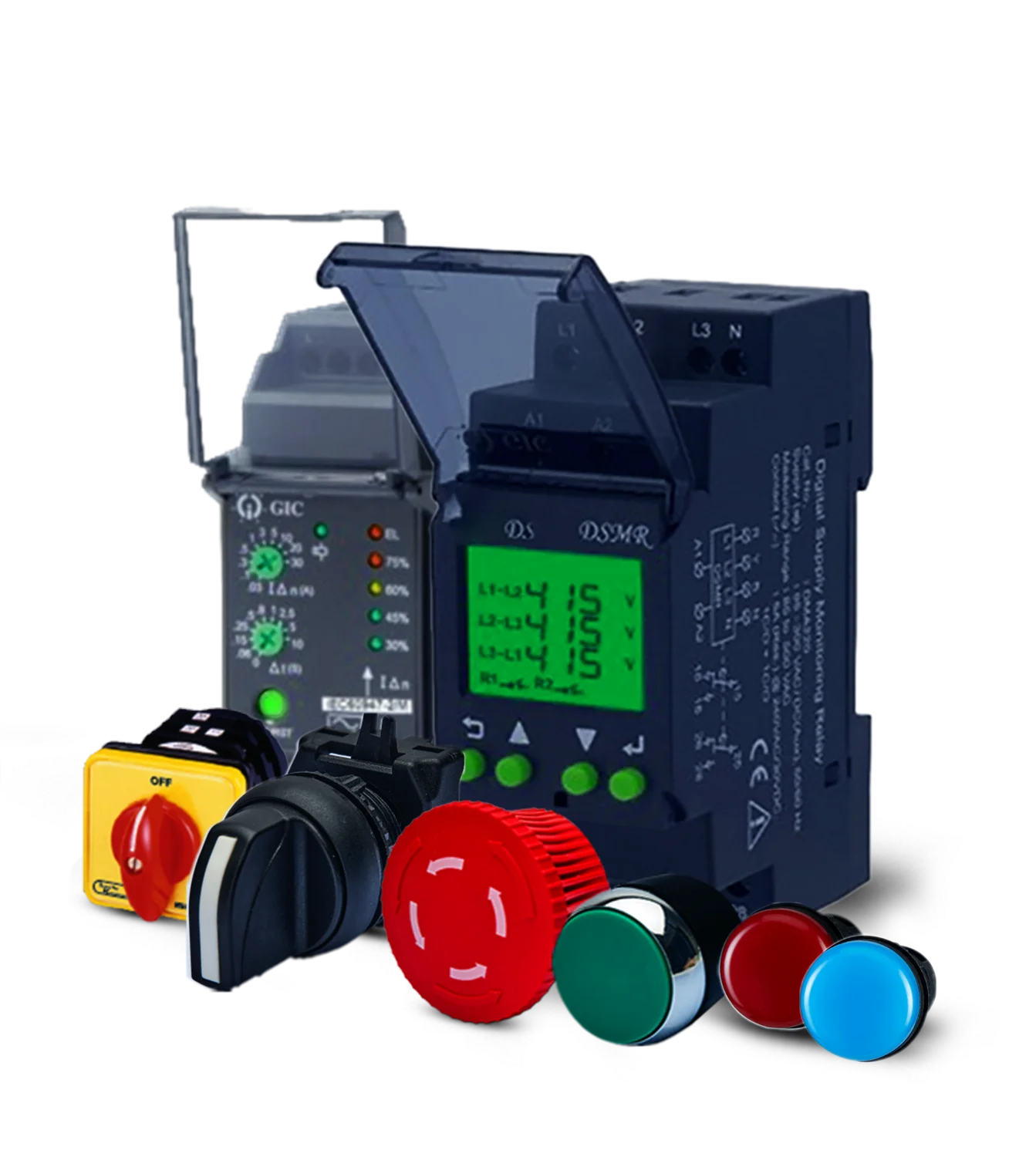
Modern numerical relays simplify testing considerably through programmable interfaces and monitoring functions. Some systems also use control selectors during testing and maintenance procedures for operational safety and isolation management.
Also Read: How Protection Relays Detect Faults in Electrical Networks
Electrical faults rarely provide warning before occurring. A sudden overload or short circuit can damage equipment quickly if protective systems fail to respond properly. That is exactly why dependable relay protection remains such an important part of modern electrical infrastructure.
Understanding the overcurrent relay working principle helps engineers and facility operators build safer and more reliable electrical systems. From feeder protection to transformer backup and motor protection, relays help isolate faults before serious operational or equipment damage develops.
Lauritz Knudsen Electrical & Automation offers dependable protection solutions through OCR11, FDR21, and FDR22 numerical relays designed for feeder monitoring, earth fault protection, selective coordination, and reliable low-voltage as well as medium-voltage electrical applications.
No. Relays only detect abnormal conditions and send trip signals. Circuit breakers perform the actual isolation process required to disconnect faulty electrical sections safely from the system.
Numerical relays provide improved accuracy, monitoring, communication capabilities, programmable protection functions, event recording, and simplified coordination compared to older electromechanical relay technologies used previously.
Yes, many renewable installations use relay protection for feeder monitoring, inverter protection, transformer backup protection, and maintaining electrical safety across solar and wind distribution networks.
Testing schedules depend on operational conditions, industry standards, and system criticality. Industrial facilities generally conduct periodic relay testing to maintain dependable protection performance and coordination reliability.
Yes. Improper relay settings may delay fault isolation or cause unnecessary tripping, potentially affecting operational continuity, equipment safety, and overall electrical system protection performance.
Rajesh R Shirodkar,
DGM-Corporate CommunicationTest
Quick Links
Miniature Circuit Breaker | Air Circuit Breaker | Home Automation Systems | Modular Switches | Variable Frequency Drives | Energy Management System | IEC 61439 Panels | Moulded Case Circuit Breakers | AC DRIVE | Submersible Pump Motor Starter | Mobile Starter | Industrial Automation | Residual Current Circuit breaker | APFC controller | Power Factor Correction | Motor Protection Device | Medium Voltage | Vacuum Circuit Breaker | Programmable Logic Controllers | Human Machine Interface | Solar MCCB
Assistance Required?
Select an option to Contact Us

 Contact Us

