Technical Articles
India’s shift toward electric mobility is moving at an incredible pace. It is a testament to how quickly we adopt better technology. As part of this progression, the charging experience is also getting a major boost. A smart EV charger offers a high level of control and insight. It turns a daily routine into an automated, data-driven process.
By balancing energy needs intelligently, it allows owners to get the absolute best performance from their home setup. It is a positive step that adds real value to the ownership experience.
We need to look at what sets this hardware apart. A smart EV charger does more than just deliver electricity. It gathers data and offers real-time control via a mobile application. This builds a complete EV smart charging system that fits your daily routine. It prioritises safety and efficiency rather than just supplying raw power.
Here are the top five reasons why upgrading to a smart unit is the right choice for Indian road conditions.
Saving money is a huge factor in buying an EV. However, electricity rates in many states change based on the time of day. Peak hours cost more, while late nights are cheaper. A standard charger draws power the second you plug it in. This usually happens right when rates are highest in the evening.
A smart EV charger solves this problem. You can plug your car in when you return from work at 7 PM, but set it to start charging at midnight. This simple adjustment helps you grab the lowest Time-of-Day tariffs. These savings add up significantly over the life of the vehicle.
Drivers often assume that higher power ratings always mean a better charge. That is not always true. High-speed charging is vital for highway trips, but it is often overkill for daily city driving. An EV charger acts as a gateway that talks to the Battery Management System to agree on a safe energy flow. If a vehicle cannot handle high input power, plugging into an ultra-fast station gives you no operational advantage. The car will just limit the intake to its maximum capacity.
Also, using high-voltage DC charging too often creates heat inside the cells. This thermal stress can wear down the battery chemistry over the vehicle's life. For daily top-ups, a standard AC EV charger is the more efficient choice.
Homeowners often worry that installing a private EV charger requires industrial-grade wiring. That is rarely true. The installation process is straightforward for most Indian residences. Existing infrastructure can usually support single-phase AC chargers between 3.3kW and 7.4kW.
These units provide enough power to charge a vehicle overnight without overloading the domestic supply. You generally do not need a three-phase connection unless you choose a high-capacity 22kW unit. Modern charging units fit smoothly into standard electrical setups with minimal intervention.
Public infrastructure solves range anxiety, but using it daily is not cost-effective. Public stations have to cover operational costs and commercial electricity tariffs. These factors drive up the price per unit of electricity.
Data suggests that home charging is two to three times cheaper than public alternatives for daily needs. Investing in a dedicated home EV charger allows you to use lower domestic rates. It also offers the convenience of waking up to a full battery every morning.
When you evaluate the various types of EV chargers on the market, look at three technical factors to ensure the device matches your requirements.
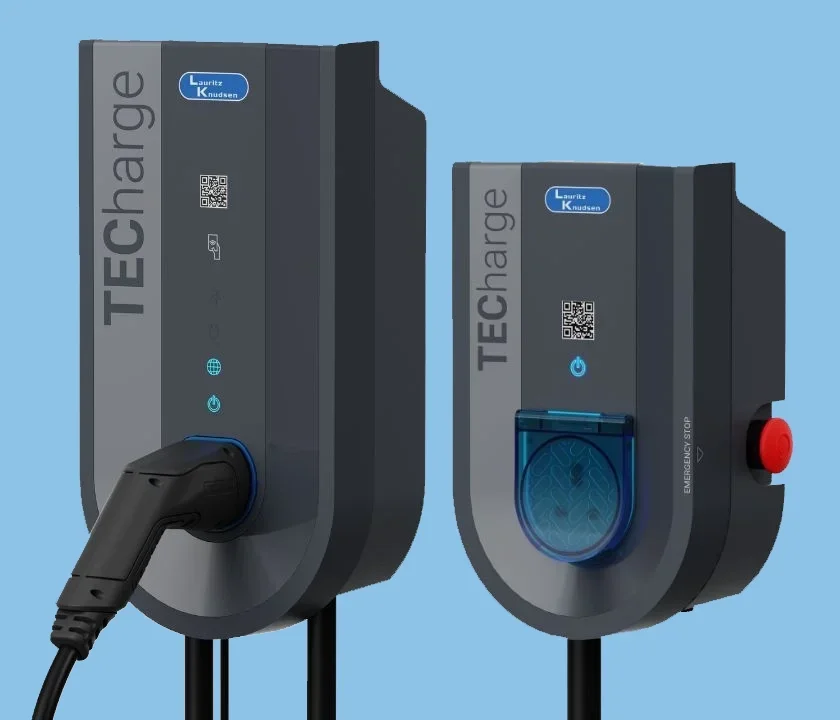
Lauritz Knudsen Electrical & Automation prioritises safety and efficiency. We built TECharge on this philosophy. It is our integrated EV charging solution designed to create a complete ecosystem for residential users, commercial spaces, and fleet operators.
The TECharge portfolio features robust AC chargers in 3.3kW, 7.4kW, and 22kW variants. We adhere to global standards to ensure hardware compliance. Beyond the box, we provide a sophisticated Charging Management System for real-time monitoring and secure billing. We also built the TECharge Mobile App to enhance the user experience. It allows users to locate stations and manage sessions effortlessly.
Our solutions include versatile connectivity options such as WiFi, Ethernet, 4G, and BLE to ensure a secure and future-ready infrastructure.
A 7.4kW AC charger is the ideal choice for most personal vehicles in India as it balances speed and electrical load. Smaller 3.3kW units suit hybrids, while 22kW chargers require three-phase connections.
Charging duration depends on the battery size and the charger's output. A typical 40kWh battery takes 6 to 8 hours with a 7.4kW charger. A slower 3.3kW unit often requires 12 to 15 hours for a full charge.
Essential features include app connectivity for remote monitoring and scheduling to optimise costs. You should also prioritise load balancing to protect your home grid and authentication tools like RFID to prevent unauthorised usage.
Chargers stop during outages, but quality units like TECharge offer built-in protection against fluctuations. They pause charging if voltage levels become unsafe and automatically resume once the supply stabilises to protect the vehicle electronics.
Installation is a standard procedure for certified professionals. It involves mounting, connecting to the distribution board, and earthing. The process is simple for single-phase units, though older homes may need a wiring inspection.
Assistance Required?
Select an option to Contact Us
 Contact Us

